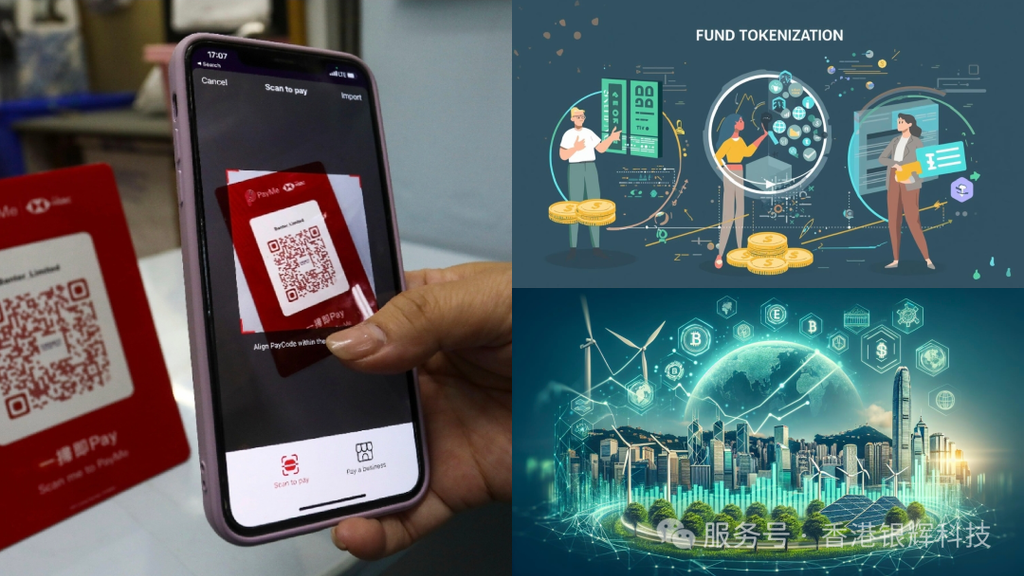
On October 23, 2026, HSBC launched the Hong Kong dollar stablecoin RedCoin in Hong Kong and made it available for personal transfers and merchant payments through PayMe. This also marks the first time a licensed Hong Kong dollar stablecoin has been integrated into a mainstream payment application. Whether it can generate stable payment demand will be a key focus for the market going forward.
| What Changes Are Taking Place in Hong Kong’s Digital Finance Market?
In April this year, the Hong Kong Monetary Authority (HKMA) issued the first two stablecoin issuer licences to HSBC and Anchorpoint Financial Technology Limited. Six months later, RedCoin was integrated into PayMe.
In investment and trading, the Securities and Futures Commission of Hong Kong announced a regulatory framework for secondary market trading of tokenised products in April. On October 26, the ChinaAMC Hong Kong Dollar Digital Currency Fund and the ChinaAMC US Dollar Digital Currency Fund began secondary market trading on licensed virtual asset trading platforms, supporting round-the-clock trading.
In the bond market, the issuance results of Hong Kong’s fourth batch of digital green bonds were announced in September, with a total issuance size equivalent to approximately HK$20 billion. For the first time, tokenised deposits were introduced into the primary issuance and settlement of Hong Kong dollar bonds.
Payments, fund trading and bond settlement have been progressively implemented.
| Different Business Activities Are Creating New Requirements for Financial Services
Payments, Investments and Bond Businesses Have Different Priorities
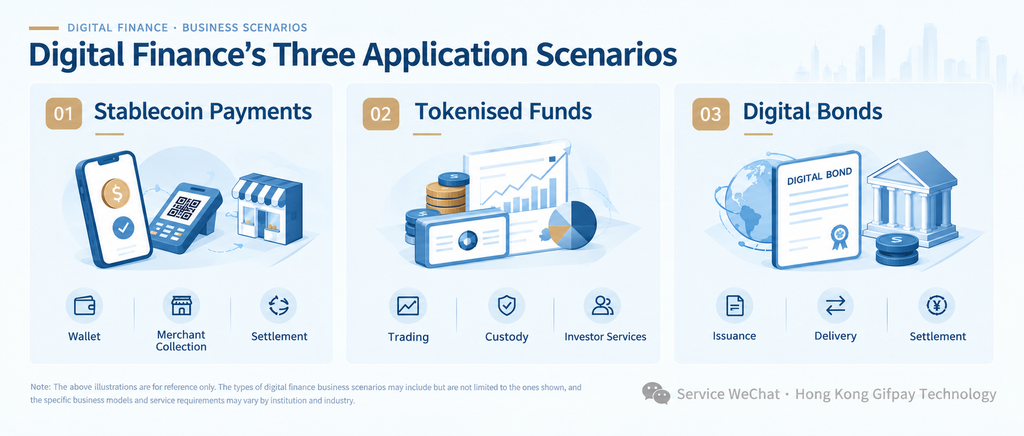
Stablecoin payments require user wallets, merchant acceptance services and reliable payment and settlement arrangements to ensure that payment instructions are processed and funds are settled in accordance with established rules.
Tokenised funds entering the secondary market require support from trading platforms and also involve fund management, asset custody and investor services. Digital bonds, meanwhile, involve issuance, delivery and settlement, requiring coordination among relevant institutions and systems to complete transactions.
Once these businesses are operational, financial institutions must also handle transaction reconciliation, fund settlement and day-to-day operations.
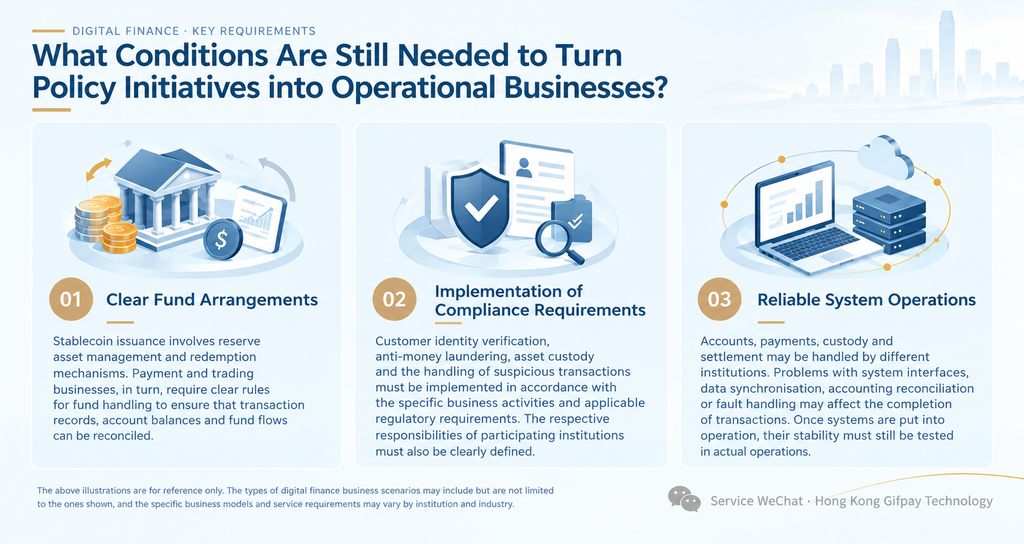
| What Conditions Are Still Needed to Turn Policy Initiatives into Operational Businesses?
Clear Fund Arrangements
Stablecoin issuance involves reserve asset management and redemption mechanisms. Payment and trading businesses, in turn, require clear rules for fund handling to ensure that transaction records, account balances and fund flows can be reconciled.
Implementation of Compliance Requirements
Customer identity verification, anti-money laundering, asset custody and the handling of suspicious transactions must be implemented in accordance with the specific business activities and applicable regulatory requirements. The respective responsibilities of participating institutions must also be clearly defined.
Reliable System Operations
Accounts, payments, custody and settlement may be handled by different institutions. Problems with system interfaces, data synchronisation, accounting reconciliation or fault handling may affect the completion of transactions. Once systems are put into operation, their stability must still be tested in actual operations.
| Project Agorá Explores New Models for Cross-Border Payments
Project Agorá, jointly advanced by the Bank for International Settlements and the Institute of International Finance, explores the use of tokenised commercial bank deposits and tokenised central bank reserves to support cross-border wholesale payments.
From July to August 2026, the project conducted real-value testing involving 28 central banks and financial institutions across 17 types of transaction scenarios, with a total transaction value of approximately CHF 800,000. Among these, 30 trial transactions announced by the Bank of Korea involved six currencies, with an average time of approximately 80 seconds from the issuance of a payment instruction to the completion of settlement.
Such testing provides validation of the relevant mechanisms through real-value transactions. However, large-scale commercial applications still require further evaluation of operational, governance and legal arrangements.
| The Next Stage of Hong Kong’s Digital Finance Development
From institutional development to practical applications, Hong Kong’s digital finance sector is gradually expanding into new business scenarios. As stablecoin payments and tokenised asset trading are progressively introduced, market demand for services such as payment and settlement, asset custody, account management and system operations will become more specific.
For financial institutions and cross-border business participants, the next step is to assess, in light of their respective business scenarios, whether existing systems and services can meet the requirements of actual transactions and operations.
This article is for industry observation purposes only and does not constitute investment or business advice. Business arrangements involving mainland China should be assessed separately in accordance with applicable laws and regulations.