

“Since the same overseas large models are being accessed, why do some platforms charge only half of the official price, or even less?” This is a question many enterprises encounter when adopting AI.
Lower prices and more convenient access naturally make enterprises inclined toward low-cost solutions. However, once AI enters core business operations, a key question emerges: where exactly do the differences behind low prices lie?
| Opaque Models Behind Low-Cost AI Services
With the growing demand for overseas large models, some third-party AI API service providers offer model access capabilities through resource integration, API forwarding, and other approaches. However, due to a lack of transparency regarding authorization relationships and resource sources, these services are often referred to as “gray AI intermediary services.”
Such services attract users with low prices, but enterprises need to pay attention to the following risks during actual use:
Unclear Resource Sources
The authorization status of model access resources provided by some service providers is unclear. Once enterprises become dependent on these services for the long term, they may face service interruption and business compliance risks.
Unclear Service Capabilities
Although some platforms claim to support multiple mainstream large models, certain platforms do not disclose the actual API routing paths and model versions. Users may find it difficult to determine whether the actual service capabilities received are consistent with the advertised capabilities.
Unclear Data Processing
Some platforms lack clear explanations regarding user data storage and transmission processes. Enterprise-sensitive information may face risks of leakage or improper use.
Low-cost solutions can lower the entry barrier for AI adoption, but enterprises still need to address more challenges when applying AI in real business scenarios.
| Enterprise AI Selection Criteria Are Changing
In the early stages of AI adoption, AI was mainly used to improve efficiency, and enterprises focused more on access speed and cost. As AI gradually enters business scenarios such as software development, content production, and knowledge services, enterprise requirements for services continue to increase.
From Price to Service Quality
In real business applications, enterprises are no longer only concerned with whether they can access models, but whether model outputs are stable and whether service responses are reliable.
From Model Access to Data Security
As increasing amounts of business data enter AI systems, whether data processing is controllable and whether sensitive information may be exposed have become critical considerations for enterprises.
From One-Time Access to Long-Term Service Capability
Once AI becomes embedded into business processes, enterprises need more than just an API. They require a service system that can continuously support business operations, including technical support, service assurance, and business expansion capabilities.
Enterprise requirements for AI services are shifting from simply being able to access models toward stable, secure, and sustainable service assurance. The subsidiary of Yinhui Technology, Zhongheng Zhihui, focuses on this transformation and explores global AI service application models.
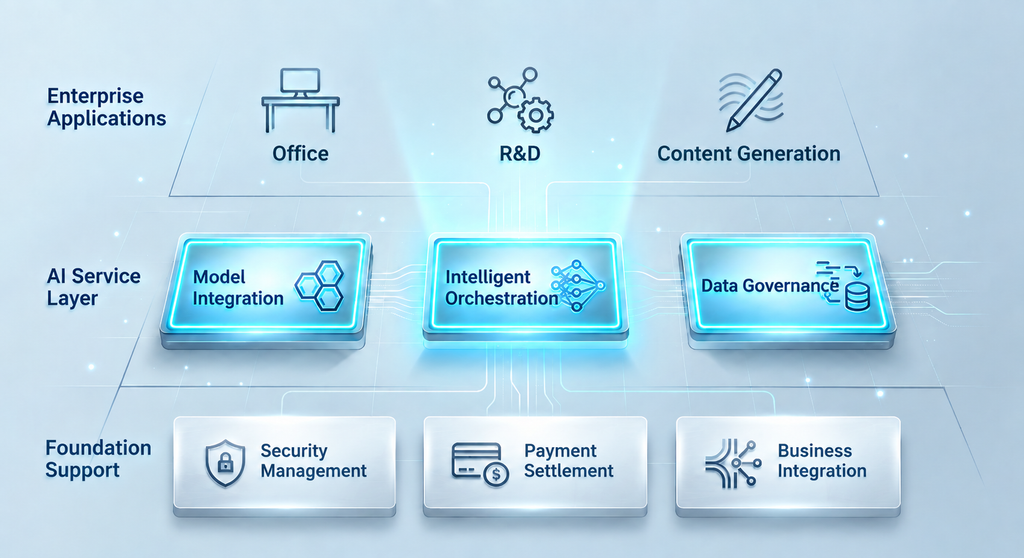
(As AI becomes deeply integrated into enterprise operations, businesses no longer need only a model access point, but rather a stable, trusted, and sustainable AI service ecosystem.)
| AI Services Enter a Stage of Standardized Development
Alongside the implementation of AI applications, issues related to authorization, marketing claims, and operational practices in the commercialization process have gradually attracted attention.
In 2023, Shanghai Entropy Cloud Network Technology Co., Ltd. was found to have engaged in unfair competition by operating services related to “ChatGPT Online,” using identifiers associated with OpenAI, and charging users under the name of “ChatGPT Chinese Version.” The company was subsequently penalized.
This case demonstrates that AI service commercialization requires not only technical capabilities but also standardized operational practices.
Meanwhile, regulations such as the Interim Measures for the Management of Generative Artificial Intelligence Services, as well as the Data Security Law and the Personal Information Protection Law, continue to improve requirements for AI service operations and data processing.
Focusing on the global application needs of AI services, Zhongheng Zhihui explores infrastructure capabilities that integrate both business connectivity and standardized operations.
| Zhongheng Zhihui: Supporting the Globalization of AI Services
As a pilot enterprise included in the “Data Processing with Access Approval” (白名单试点) program of the Shantou Overseas Chinese Economic and Cultural Cooperation Experimental Zone, Zhongheng Zhihui focuses on AI service overseas expansion scenarios and strengthens cross-border transaction support and ecosystem connectivity capabilities.
Connecting Cross-Border Transaction and Settlement Processes for AI Services
Zhongheng Zhihui has completed validation of cross-border settlement scenarios based on Token (AI model access resources) computing service capabilities. The company explores the integration of business processes covering overseas service delivery, compliant cross-border foreign exchange collection, and settlement, supporting AI service providers with payment collection and settlement requirements during their global expansion.
Building Ecosystem Connectivity Capabilities for AI Service Global Expansion
Zhongheng Zhihui collaborates with telecom operators such as China Telecom and China Mobile, as well as model providers, computing power enterprises, and cloud service providers, promoting the coordinated development of models, computing resources, networks, and financial service capabilities.
In the future, the global development of AI services will evolve from simple model access toward comprehensive development of technology, services, and compliance capabilities. A stable, transparent, and reliable service ecosystem will become an important foundation for the large-scale adoption of AI applications.